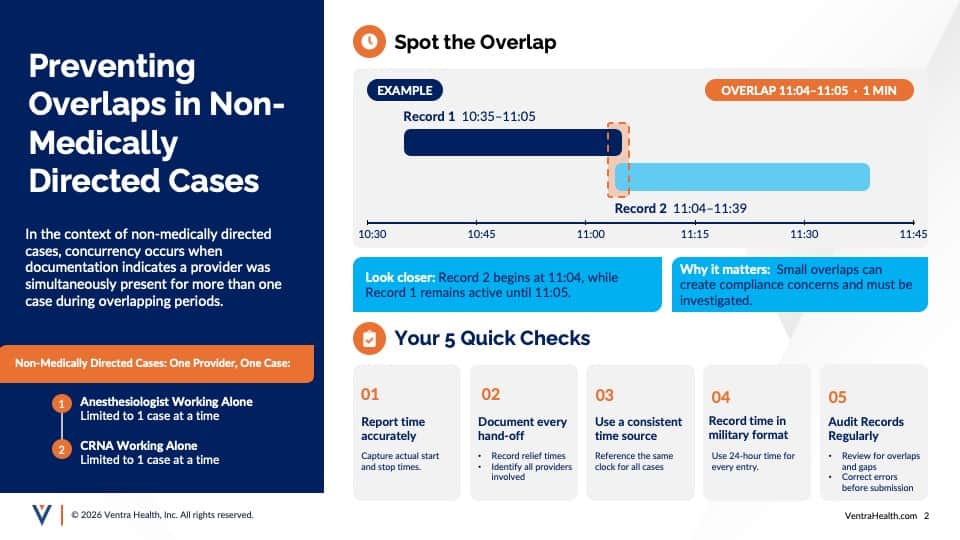
A one-minute documentation overlap may appear minor, but it can signal a meaningful compliance issue in a non-medically directed anesthesia case. Careful time reporting, complete hand-off documentation, and routine record review help physician groups and health systems identify these conflicts before claims are submitted.
Download our Guide for a concise visual example and five quick documentation checks your teams can use before claim submission.
One provider, one case
For non-medically directed cases, an anesthesiologist working alone is limited to one case at a time. The same principle applies to a CRNA working alone. Concurrency occurs when documentation indicates that a provider was simultaneously present for more than one case during overlapping periods.
The issue is not limited to lengthy conflicts. Consider two records:
- Record 1: 10:35-11:05
- Record 2: 11:04-11:39
Because the second case begins at 11:04 while the first remains active until 11:05, the records contain a one-minute overlap. Even a brief overlap requires investigation to determine whether the documentation accurately reflects the care provided, whether a hand-off occurred, or whether a time-entry error needs to be corrected.
Five checks that strengthen documentation
1. Report time accurately
Capture the actual start and stop times for each case. Estimates, rounded times, and entries made from memory can create discrepancies that are difficult to reconcile later.
2. Document every hand-off
Record relief times and identify every provider involved. Complete hand-off documentation helps explain changes in provider responsibility and gives billing and compliance teams the information needed to evaluate an apparent overlap.
3. Use a consistent time source
Reference the same clock for all cases. When different devices or systems are not synchronized, their timestamps can create an overlap that did not occur clinically.
4. Use military time
Record every time in 24-hour format. A consistent format reduces ambiguity and supports a more efficient review across anesthesia records, operating-room systems, and billing workflows.
5. Audit records regularly
Review documentation for both overlaps and gaps, then correct errors before submission. A focused pre-bill review can prevent an avoidable discrepancy from reaching the claim and becoming a larger compliance concern.
Build prevention into the workflow
Preventing overlaps depends on more than identifying them after the fact. Physician groups and health systems need a repeatable process that aligns clinical documentation, provider hand-offs, timekeeping, coding, and pre-bill review. Clear expectations at the point of care, paired with routine auditing, help revenue cycle and compliance teams address inconsistencies while the details are still available.