On November 4, 2026, the Centers for Medicare and Medicaid Services (CMS) finalized the Calendar Year (CY) 2027 Physician Fee Schedule. The rule sets concrete payment rates, quality reporting mandates, and Alternative Payment Model (APM) policy changes effective January 1, 2027. For physician leaders overseeing anesthesia, emergency medicine, hospital medicine, and radiology groups, it confirms some expected changes, extends a few important deadlines, and leaves a handful of operational questions that groups still need to resolve before the effective date.
Conversion Factors: A Confirmed Reduction
As finalized, CMS will apply two separate conversion factors, as it has since CY 2026: one for clinicians who qualify as Qualifying APM Participants (QPs) and one for everyone else. The CY 2027 qualifying APM conversion factor lands at $32.95, a 1.83% decrease from the current $33.57. The non-qualifying conversion factor falls further, to $32.63, a 2.31% decrease from $33.40.
Three factors drove this outcome:
- the statutory 0.75% update for QPs and 0.25% update for non-QPs
- a -0.12% adjustment tied to finalized work RVU changes
- the expiration of the one-year, 2.50% conversion factor increase that Congress enacted for CY 2026 under the Working Families Tax Cut legislation, which alone accounts for most of the year-over-year reduction.
For anesthesia groups, the finalized 2027 Anesthesia Conversion Factor is $20.3068 for QPs, a 1.42% decrease from 2026, and $20.1056 for non-QP services, a 1.91% decrease from 2026.

Practice Expense Changes: Why Your Net Payment May Differ from the Headline Rate
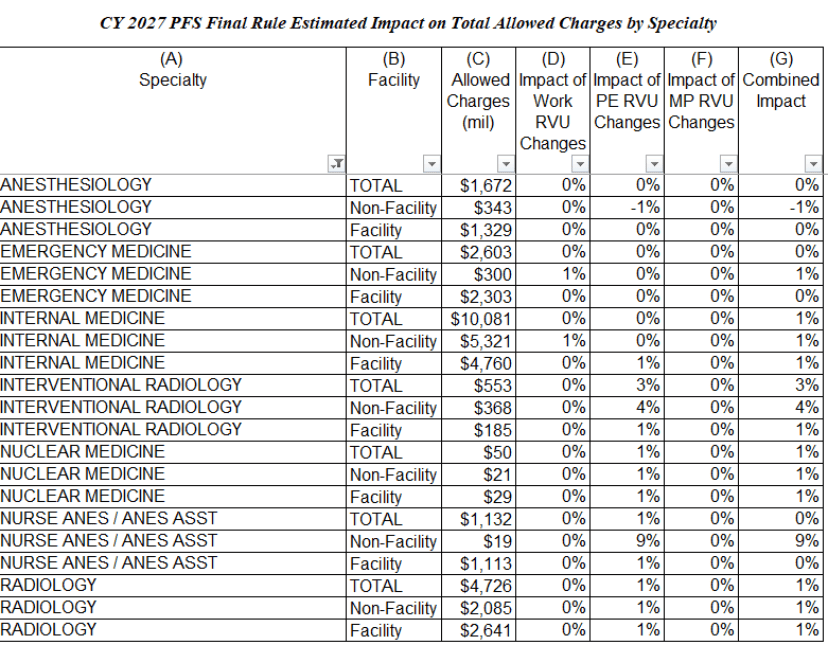
The conversion factor is only part of the payment picture. CMS finalized its reform of indirect practice expense (PE) RVUs, including updated allocation of indirect PE, a two-year phase-out of the Indirect Practice Cost Index (which relies on outdated specialty survey data), and a PE stabilizer that generally limits annual PE RVU changes to five percent. These changes can redistribute payment across specialties and sites of service, so your net impact depends on your specialty mix and where services are performed. Model your own RVU mix by site of service rather than relying on the headline rate alone.
MIPS Sunset Pushed to 2031: More Runway, Not Less Urgency
One of the most significant changes between the proposed and final rule is the timeline for transitioning away from Traditional MIPS. CMS initially proposed ending Traditional MIPS after the 2028 performance year; however, the final rule extends that timeline by two years. Traditional MIPS will now continue through the CY 2030 performance period and will be retired beginning in CY 2031. At that point, clinicians will transition to MIPS Value Pathways (MVPs) or Advanced APMs.
Importantly, transitioning to an MVP does not eliminate MIPS reporting requirements. Clinicians will continue to be evaluated across Quality, Improvement Activities, Promoting Interoperability, and Cost, as applicable. The primary difference is that MVPs use a smaller, more specialty-focused set of measures and a slightly different scoring structure, creating a more streamlined and clinically relevant approach to MIPS participation.
CMS also finalized a new requirement beginning with the CY 2027 performance year that clinicians report at least one specialty-specific Core Measure. For specialties that have historically struggled with limited outcome-measure options, this framework may provide greater flexibility than the previous outcome or high-priority measure requirement. While the extended Traditional MIPS timeline gives groups additional time to transition, it should be viewed as an opportunity to plan rather than a reason to wait. Groups should use this additional runway to evaluate the Hospitalist MVP, available measures, and their overall reporting strategy well before Traditional MIPS is retired.
Hospitalist MVP
The finalized Hospitalist MVP gives hospital medicine groups a reporting pathway built around inpatient care, care coordination, and quality outcomes relevant to hospital-based practice, closing a gap that has persisted for years. Until now, hospitalists have had no dedicated MVP. Groups have either reported Traditional MIPS using the Hospital Medicine specialty measure set or evaluated MVPs designed for other specialties and looked for the closest fit. Because MVPs use a smaller, specialty-matched set of measures, the Hospitalist MVP should make measure selection simpler and easier to build into charge capture and coding workflows.
Ambulatory Specialty Model Move Forward
Separately, CMS finalized refinements to the mandatory Ambulatory Specialty Model (ASM), a CMS Innovation Center model launching January 1 that holds selected specialists, including anesthesiologists and pain medicine physicians managing low back pain episodes, accountable for quality and cost across longitudinal chronic condition management. Participation in ASM is determined at the individual TIN/NPI level, with no general opt-out, so affected groups should confirm their selection status well before the model’s effective date.
Advanced APM QP Determinations: Confirm Before You Plan
The final rule maintains the same overall intent as the proposed rule by ensuring that clinicians who achieve QP or Partial QP status through Advanced APM participation are not required to participate in MIPS. However, the final policy differs slightly in how this status is applied across a clinician’s TIN relationships. Rather than extending an individual clinician’s full QP status across all TIN/NPI combinations, CMS will apply Partial QP status to the clinician’s other TIN reassignments. This is important for groups participating in MIPS because a clinician who earns QP status through an Advanced APM may also bill under other TINs that participate in MIPS. Under the finalized policy, those additional TIN/NPI relationships would receive Partial QP status, meaning the clinician would not be required to participate in MIPS or be subject to the group’s MIPS payment adjustment unless they elect to participate. However, because those additional TIN/NPI relationships are treated as Partial QPs rather than QPs, services billed under those TINs would not receive the enhanced QP Physician Fee Schedule conversion factor update. The group may continue to report MIPS for its other eligible clinicians, while the clinician’s MIPS exclusion and QP payment treatment are applied based on the status of each TIN/NPI relationship.
How Ventra Health Helps You Navigate What Comes Next
Ventra’s dedicated MIPS Team is here to help translate what the Final Rule means to your specialty and practice. The team is also reviewing the APM and QP determination language for multi-TIN implications, which helps you confirm whether your providers’ will be impacted.
Regulatory change shouldn’t pull your attention away from patient care. Reach out to your Ventra Health Client Success Team to review any additional questions before the January 1, 2027, effective date. Or contact us here to learn more about how Ventra can help your organization.