Solving Real-World Revenue Challenges with Actionable AI
From client presentations to RFPs, we’re asked on a near-daily basis if Ventra Health is using AI technology. I believe they are asking the wrong question. The benchmark for vendor quality isn’t technology, it’s performance. They should be asking: What are the key performance metrics we deliver on, and how is technology being leveraged to achieve the results?
This paradigm is at the heart of Ventra Health’s AI strategy. It was critical, in our estimation, that we go beyond RPA and AI assist technology to deliver solutions with actionability to maximize reimbursement and improve profitability for our clients. Beyond static insights and basic workflow assistance, we wanted our solutions to continuously find opportunities for improvement—and to automate evidence-based actions—through the last mile of the revenue cycle.
Strategically, we focused on solutions that would capitalize on Ventra’s greatest strength: our people. To significantly impact revenue performance, the technology would need to make our teams more effective—improving decision making, increasing both precision and speed, and enabling teams to shift attention to higher impact tasks.
It would also need highly reliable data, and for more than three years, we have curated our own. vSight™, our industry-leading data & analytics platform, allows us to accurately identify payer behavior and denial patterns, developing effective predictive modeling solutions based on substantial historical outcomes data.
With the official launch of Ventra’s vCision™ revenue intelligence platform, we’re implementing high-precision, AI-driven solutions that powerfully protect against the market forces that are eroding revenue for our clients. Now an integral part of Ventra’s enterprise service delivery, vCision empowers our revenue cycle management (RCM) experts to make smarter, faster decisions. As a result, they are solving real-world revenue challenges in several ways. Here are just a few examples.
Improve Claim Processing Accuracy
Cleaner claims reduce the timeline from service to reimbursement, accelerating collections and improving cash flow. Automation is now commonly used in RCM to check claims for errors before submission. We’ve taken claim accuracy to a new level with actionable solutions that improve processes across the entire workflow.
Demographic data entry: Our AI-driven models can read and extract patient data from scanned and handwritten documents, loading them directly into the billing platform. This not only speeds up manual data entry, but it also significantly reduces the margin of error. This is highly impactful in specialties such as radiology and anesthesia, where patients generate a significant volume of handwritten documents.
Intelligent coding support: We designed automated coding support technology that is integrated into the workflow and incorporates expert human oversight to ensure quality. The time it saves allows our enterprise service delivery teams to focus more attention on complex and exception visits.
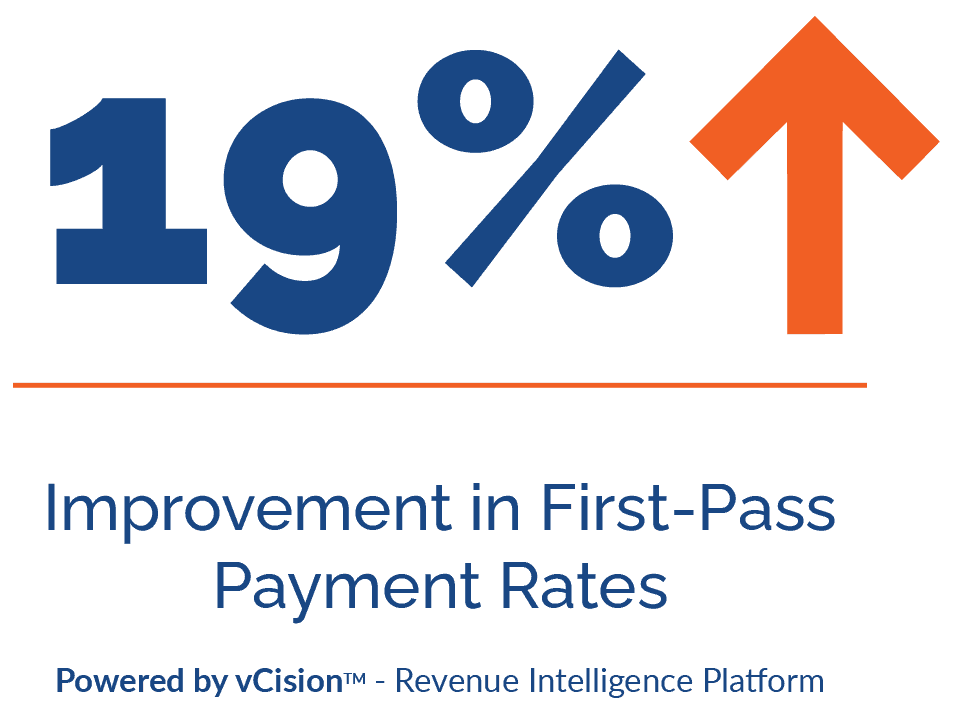
Quality and consistency: Our solutions support continuous improvement in quality and claim consistency for our teams, facilitating near real-time remediation with training and education, as well as expanded sample sizes for targeted quality control. With vCision solutions for improved claim processing accuracy, we’re able to improve first-pass payment rates by 19%.
Reduce Preventable Denials
Payers denied nearly 20% of in-network claims in 2024, according to a recent CBS News Analysis of 1.3 billion federal health insurance claims.1 To counter that, providers spent nearly $18 billion fighting payers on claim denials that were ultimately overturned and paid.2
The economics are unsustainable, and we’re leveraging actionable AI solutions end-to-end across the revenue cycle in order to change them.
Prevent: Clean claims are a critical first step, as nearly half of providers say missing or inaccurate data is the root cause of claim denials.3 vCision solutions that improve processing accuracy have a downstream positive effect on denials.
Predict: Leveraging a full spectrum of payer data from both vSight and external sources, our solutions accurately predict errors or omissions that are likely to lead to denials for each payer. Denial checks are integrated throughout the billing cycle, alerting our billing teams along the way and automatically correcting issues.
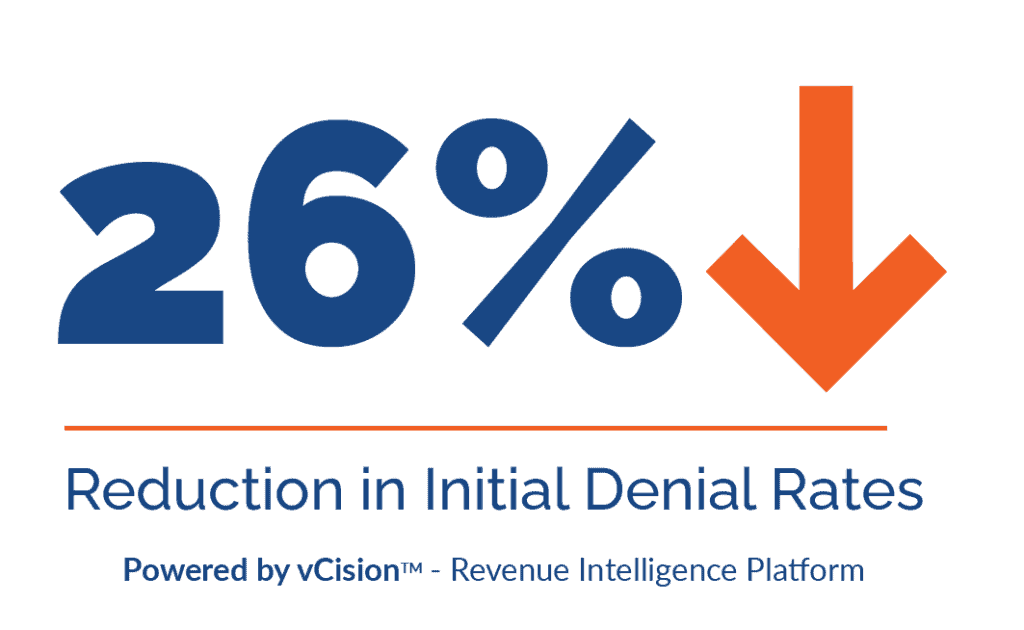
Respond: When we do encounter claim denials, our AI-powered Denial Agent accelerates the mitigation process by automatically selecting the next best action and executing the response workflow. The solution draws on our significant domain expertise and payer behavior data to make evidence-based suggestions for denial response. Actions are automated based on historical data of the highest probability of success. By taking a comprehensive, end-to-end approach to AI-powered denial management, we can deliver a 26% reduction in initial denial rates for our clients.
Anticipate and Adapt to Changing Payer Behavior
There’s considerable speculation among providers that payers are using AI to deny claims and delay payments. Curated data and AI-powered revenue intelligence solutions offer a strong counterpoint, allowing us to stay ahead of the elusive payer regulatory landscape.
Our data analysts—including our 24/7 Performance Surveillance Team—are using AI and automation to monitor client metrics and correct issues before they impact revenue. A spike in denials from a particular payer, for example, is often how we first discover that a payer has changed a policy or procedure.
A new on-demand, self-service digital data analyst will make it even easier for Ventra teams and clients to access these insights. With the launch this year of Insight Agent on the vCision platform, they will be able to ask questions, in natural language, drilling down into problem areas through back-and-forth conversation. For example, conversation with the agent can analyze a trending increase in “denials for additional information,” perhaps identifying a payer behavior change responsible for the spike and enabling teams to adjust processes to avoid future denials. The agent will be integrated into vSight, providing a single pane of glass through which they can interact with the data.
Reduce Revenue Leakage
Decades of declining physician reimbursement4 has forced practices to become more vigilant, closing revenue gaps and pursuing all available and appropriate reimbursement. AI and automation solutions are giving us creative new ways to uncover missed reimbursement opportunities and reduce revenue leakage.
Charge capture: It’s easy to miss billable services within physician documentation, particularly in specialties such as anesthesia and radiology that have unique billing challenges. Our teams are leveraging AI solutions to extract procedure data, timing, and provider details from medical records and to automatically create validated charges in the billing platform. The solution catches easily overlooked charges, such as a fee-based anesthesia block missed among the time-based anesthesia services, or one missed radiology view that inadvertently prevents the study from being classified as a complete versus a limited scan.
Efficient follow-up: Delay tactics are part of payer strategy,5 but AI and automation help practices regain the upper hand. Our Follow-Up Agent on the vCision platform goes beyond industry standard alerts on aging claims. It accelerates the no-response claim resolution process by automatically selecting the next best action and executing the response workflow. Automated responses are integrated with payer processes to comply with their preferred channels, whether via APIs, payer portals, or voice calls.
A Strategy for Actionability
Altogether, the vCision revenue intelligence platform is comprised of nine AI and automation solutions. What elevates them from simple efficiency-based tools to actionable solutions that improve cash flow and increase reimbursement for our clients?
First, these are not a disconnected suite of products with isolated functions and features. The vCision platform represents a coordinated roadmap focused on making the largest impact on our highest transactional workflows. It will continue to evolve, with plans already underway for phases two and three in the coming years.
Further, they are expert-guided solutions that enhance Ventra’s white-glove approach to service. Our AI and automation solutions are rigorously monitored and continually optimized by people with deep RCM expertise. vCision technology doesn’t replace our experts; it gives them insights to anticipate revenue challenges and to act faster with evidence-based courses of action.
We prove this continually with measurable results. Our revenue intelligence solutions tie directly to our core service metrics, so we have the reporting infrastructure in place to verify that we’re improving profitability for every Ventra client.
During a time of rapid tech evolution, there’s a risk that new technology initiatives will expend considerable effort to achieve only incremental change. The key is to remain laser-focused on organizational mission, continually reviewing clients’ most pressing real-world challenges and innovating new ways to solve them.
→ Talk to an ExpertWritten by:

Chief Technology & Data Officer
About David Reck
As Chief Technology and Data Officer, David leads the Data & Analytics and IT teams within Ventra Health creating analytical dashboards, predictive models, and automation solutions. He is passionate about using data-driven technology to solve complex healthcare problems. David has over 20 years of custom solution development experience. David has deep technical experience in building scalable products and analytics deployed to the cloud. He is a champion of Agile development methodologies allowing his teams to shorten client feedback loops, better align with client emerging priorities, and deliver incremental client value at a rapid pace.
Resources:
1 “State of denial: How insurance companies impact health care today,” CBS News Sunday Morning, January 11, 2026, accessed January 29, 2026, at https://www.cbsnews.com/news/state-of-denial-how-insurance-companies-impact-health-care-today/
2 AHA Statement to House W&M Committee for Hearing with Health Insurance CEOs, American Hospital Association, January 22, 2026, accessed January 29, 2026, at https://www.aha.org/testimony/2026-01-21-aha-statement-house-wm-committee-hearing-health-insurance-ceos
3 “Three-quarters of providers say claim denials increasing,” xtelligent Rev Cycle Management, September 26, 2024, accessed January 29, 2026, at https://www.techtarget.com/revcyclemanagement/news/366612016/Three-quarters-of-providers-say-claim-denials-increasing
4 American Hospital Association infographic, “Medicare physician payment continues to fall further behind practice cost inflation,” updated January 2025, accessed January 29, 2026, at https://www.ama-assn.org/system/files/2025-medicare-updates-inflation-chart.pdf
5 “4 Bad Payer Behaviors that are Impacting Reimbursement for Facility-Based Physician Groups,” Becker’s Hospital Review, January 31, 2025, accessed January 29, 2026, at https://www.beckershospitalreview.com/hospital-management-administration/4-bad-payer-behaviors-that-are-impacting-reimbursement-for-facility-based-physician-groups/
Connect With Us
Find Out More About Ventra Health
Provide a few details about your needs, and a member of our team will follow up to discuss how we can help.